Top Industrial Ball Bearings Manufacturers Worldwide
Industrial Ball Bearings keep motors, pumps, conveyors, and turbines turning under demanding conditions. Their performance depends on more than a familiar brand name. Steel cleanliness, raceway geometry, heat treatment, lubrication, seals, and installation all matter. A bearing can look flawless on a workbench and still fail early if its fit or operating environment is wrong.
This overview examines leading Industrial Ball Bearings manufacturers worldwide, including established groups such as SKF, NSK, NTN, Schaeffler, Timken, and JTEKT. Their strengths differ. One may offer broad global service; another may excel in specialized designs or application support. A useful perspective comes from A. B. Jones, the influential bearing engineer associated with precision bearing design. In paraphrase, his engineering legacy reminds buyers that bearing accuracy depends on the whole design and manufacturing system, not one impressive specification. That is not a verified verbatim quotation, and the distinction matters.
The sections ahead compare product range, engineering capability, quality systems, distribution, and suitability for real operating conditions. Picture a conveyor running through a dusty plant, or a high-speed spindle where heat builds quickly. Each case calls for different priorities. Rankings can help readers start their research, but they cannot replace checking load, speed, temperature, lubrication, and service access. Even a well-known manufacturer may not be the best fit. That is worth remembering. This guide aims to be practical, though no short list can capture every regional supplier or application nuance.
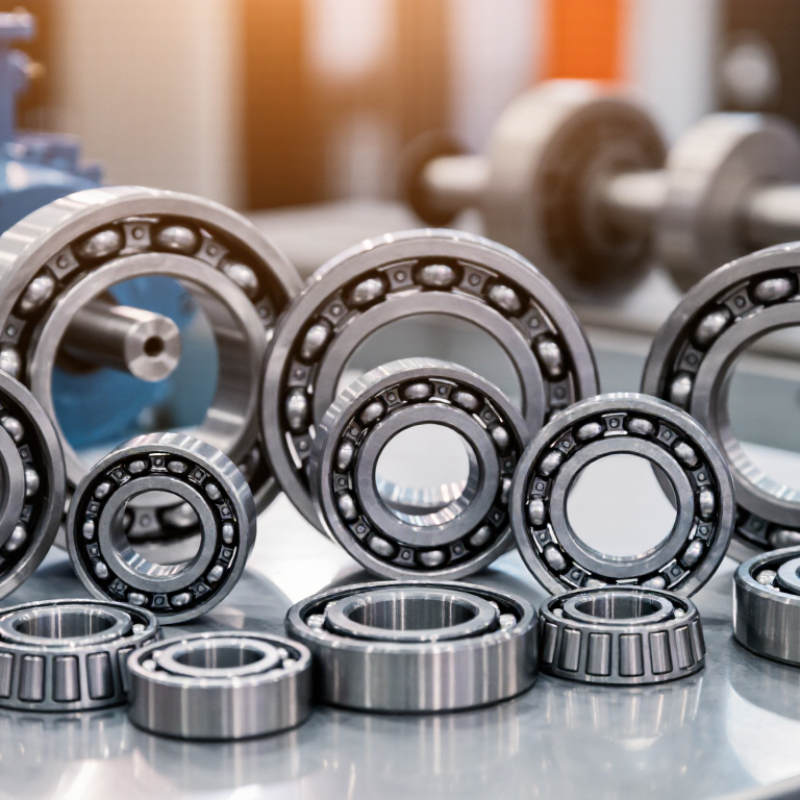
Types, Functions, and Industrial Applications of Ball Bearings
Ball bearings reduce friction while carrying radial loads, axial loads, or both. Deep-groove designs are common in electric motors, pumps, and fans because they handle everyday speeds and loads. Angular-contact bearings support combined loads in machine-tool spindles, where alignment and heat matter. Thrust bearings manage axial force in turntables and gear assemblies. Self-aligning types tolerate modest shaft misalignment, but they cannot correct poor installation.
Selection depends on load, speed, lubrication, contamination, and operating temperature. ISO 281:2007 provides methods for calculating bearing rating life; it does not guarantee a specific service life in real equipment. The U.S. Department of Energy’s 2014 Improving Motor and Drive System Performance sourcebook estimates that motor-driven systems use about 68% of U.S. manufacturing electricity. That scale makes bearing condition relevant to energy use and maintenance planning. Small parts. Big consequences.
In a conveyor, a sealed bearing may resist dust, while a high-speed spindle needs careful lubrication and tighter control. Technicians can check vibration, noise, temperature, and lubricant condition for early warning signs. Yet maintenance records are often incomplete, and a selection chart cannot capture every site condition. That gap deserves attention. A bearing that suits the load on paper may still fail early when seals, alignment, or lubrication are neglected.
Top Industrial Ball Bearings Manufacturers Worldwide - Types, Functions, and Industrial Applications of Ball Bearings
| Ball Bearing Type | Design and Function | Load Support | Typical Industrial Applications | Key Selection Consideration |
|---|---|---|---|---|
| Deep Groove Ball Bearing | Uses deep, continuous raceway grooves to guide the balls. Its simple design supports smooth rotation and is available in open or sealed configurations. | Primarily radial loads; can also support moderate axial loads in both directions. | Electric motors, pumps, fans, conveyors, gearboxes, and general-purpose machinery. | Consider speed, required lubrication, contamination protection, and the balance between radial and axial loads. |
| Angular Contact Ball Bearing | Raceways are arranged at a contact angle so the bearing can carry combined loads. Bearings are often mounted in pairs when axial loads act in both directions. | Combined radial and axial loads; axial capacity depends on contact angle and arrangement. | Machine-tool spindles, pumps, compressors, precision gearboxes, and industrial fans. | Choose the contact angle and mounting arrangement to suit the direction and magnitude of axial loads. |
| Self-Aligning Ball Bearing | Two rows of balls run on a spherical outer-ring raceway, allowing the bearing to accommodate limited shaft-to-housing misalignment. | Primarily radial loads, with limited axial-load capability depending on design and operating conditions. | Long conveyor shafts, agricultural equipment, textile machinery, and applications where alignment is difficult to maintain. | Check permissible misalignment, shaft deflection, load level, and whether the application requires an adapter sleeve. |
| Thrust Ball Bearing | Uses washer-shaped raceways and ball-and-cage assemblies to support axial forces. Single-direction and double-direction designs are available. | Axial loads in one direction or, for double-direction designs, both directions; not intended for substantial radial loads. | Vertical shafts, turntables, screw jacks, machine-tool tables, and low-speed axial-support positions. | Confirm load direction, shaft orientation, alignment, and operating speed; provide separate radial support when needed. |
| Four-Point Contact Ball Bearing | A split inner ring and four-point raceway contact allow a single bearing to accommodate axial forces from either direction in a compact arrangement. | Predominantly axial loads in both directions, with limited radial-load capacity. | Industrial gearboxes, wind-turbine components, cranes, and applications requiring compact axial support. | Evaluate axial load, clearance, ring support, and whether a separate radial bearing is required. |
| Insert Ball Bearing | A bearing insert commonly has a spherical outer surface and a locking feature for mounting in a compatible housing. It is designed for straightforward installation and replacement. | Primarily radial loads, with limited axial-load capability depending on the insert and mounting arrangement. | Mounted bearing units in agricultural machinery, conveyors, packaging equipment, and light industrial systems. | Verify housing compatibility, shaft attachment method, operating environment, and required sealing. |
Related Posts
-
2026 Top Heavy Duty Ball Bearing Types for Global Buyers
-
2026 Best Radial Deep Groove Ball Bearing Buying Guide?
-
10 Best Radial Ball Bearing Suppliers Worldwide?
-
Top Advantages of Ball and Roller Bearings for Global Buyers?
-

Why Steel Ball Bearings Are Essential for Modern Machinery and Equipment?
-

2026 Top Trends in Industrial Ball Bearings Innovations and Applications?