China Best Thin Section Bearings Overview and Applications Guide?
Thin Section Bearings are a crucial component in various industrial applications, offering unique advantages due to their reduced dimensions. As industries evolve, the demand for lightweight and compact solutions increases. Recent market reports indicate that the global thin section bearings market is expected to grow significantly, reaching a valuation of over USD 3 billion by 2026. This growth highlights the need for expertise in understanding the nuances of these components.
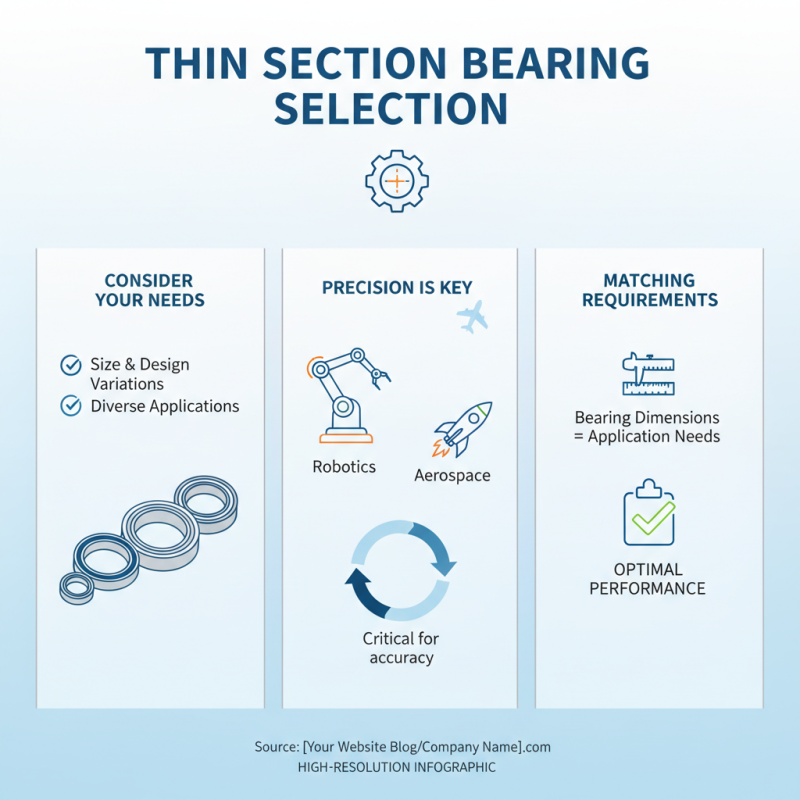
The applications for Thin Section Bearings span across numerous sectors, including aerospace, robotics, and medical devices. Their design enables them to support high radial and axial loads while maintaining low friction. In aerospace applications, weight reduction can be a game changer, improving fuel efficiency and overall performance. Yet, it is important to acknowledge that not all Thin Section Bearings are created equal. The selection of the right type can be challenging, necessitating a thorough evaluation of the specific requirements.
Quality and reliability are paramount in bearing applications. Industry reports emphasize that proper lubrication and material selection are key factors influencing performance and lifespan. Despite the advantages, engineers must remain aware of potential drawbacks, such as susceptibility to contamination and limited load capacity in some designs. Continuous innovation and attentive application are essential in harnessing the full potential of Thin Section Bearings in modern engineering challenges.

China's Leading Thin Section Bearings: An Overview
Thin section bearings play a vital role in various industries, delivering high performance in compact designs. In China, manufacturers focus on producing these specialized bearings for diverse applications. They are used in aerospace, robotics, and medical devices. The lightweight design allows for improved efficiency and reduced energy costs.
The design of thin section bearings often involves carefully selected materials. Stainless steel and ceramic are common choices due to their durability and low friction. However, manufacturers face challenges in balancing weight and strength. Achieving this balance is essential for optimal performance.
Tips: When selecting thin section bearings, consider the load requirements and environmental conditions. Ensuring proper lubrication is crucial for long-lasting performance. Regular maintenance can also extend the life of the bearings. These small yet significant components are often overlooked, but their impact on functionality is profound.
Types of Thin Section Bearings Used in Various Industries
Thin section bearings play a crucial role in various industries due to their unique design. These bearings reduce weight and space while maintaining performance. Commonly used materials include stainless steel and nylon, which contribute to their efficiency and longevity.
In aerospace and robotics, thin section bearings are indispensable. They support intricate movements with minimal friction. In medical devices, precision is essential. Thin section bearings offer reliability in tools like surgical robots and imaging machines. Their small size is a great advantage, but it can also be a challenge. Proper alignment and installation are critical for optimal performance.
In the automotive sector, these bearings enhance performance in a limited space. They help in applications like steering gear and transmissions. However, ensuring durability under rigorous conditions remains a concern. Engineers must address these challenges to improve reliability. Thin section bearings are a testament to innovation in engineering. They bring efficiency, but ongoing research is necessary to perfect their use in demanding applications.
Key Features and Benefits of Thin Section Bearings
Thin section bearings are designed to offer high performance with reduced weight and size. These characteristics make them an ideal choice for a variety of applications. They excel in situations where space is limited but precision is essential. The unique design allows for the integration of larger balls, which improves load capacity and enhances overall performance.
These bearings often feature a low profile, making them suitable for applications in robotics and aerospace. Their reduced friction leads to improved efficiency, translating into energy savings. Reliability is crucial in high-speed applications, and thin section bearings provide that by minimizing wear and tear. However, they can be more sensitive to misalignment and require careful installation to avoid premature failure.
Another key benefit is their versatility. They can be engineered to accommodate specific needs, including angular contact or radial loads. This adaptability extends their use across various industries, from medical devices to automotive components. Despite their advantages, users should be mindful of limitations, such as load capacity and environmental factors. Regular maintenance checks can further enhance their lifespan and performance.
Applications of Thin Section Bearings in Modern Technology
Thin section bearings play a crucial role in various modern technologies. Their lightweight and compact design offers significant advantages in space-constrained applications. According to industry data, thin section bearings can reduce weight by up to 50% compared to standard bearings. This reduction enhances efficiency, especially in robotics and aerospace sectors where every gram matters.
In the medical field, these bearings are vital in equipment such as MRI machines and surgical robots. They enable smooth and precise movements. A report by the Manufacturing Institute highlights that precise motion control in medical devices can improve patient outcomes significantly. Yet, the production of these bearings often comes with challenges. Manufacturers must ensure quality while managing production costs. Balancing these factors requires continuous testing and improvements.
The use of thin section bearings is also growing in renewable energy applications. They are critical in wind turbine designs, contributing to better efficiency and reliability. However, their performance can be influenced by environmental factors, which necessitates further research and innovation. Optimizing materials to withstand diverse conditions remains a key area for development in this field. The progress in these bearings reflects the ongoing evolution of technology, but challenges still linger.