What Are the Top Ball and Roller Bearing Types in 2026?

In 2026, bearing selection is less about choosing a familiar part and more about matching load, speed, alignment, and lubrication to the machine. Ball And Roller Bearing designs support electric motors, gearboxes, conveyors, pumps, and vehicle wheel hubs. Grand View Research’s Bearing Market Size report valued the global bearing market at $123.04 billion in 2023 and projected an 8.6% compound annual growth rate through 2030. This forecast places 2026 within a period of expected growth, but it does not mean every bearing type will expand at the same pace. SKF’s 2024 Annual Report provides another useful industry reference, showing how demand is shaped by different customer sectors and regions.

Details matter. Deep-groove and angular-contact ball bearings suit many compact, fast-running assemblies, while thrust bearings carry axial loads. Cylindrical, tapered, spherical, and needle roller bearings serve different combinations of radial force, shock, and misalignment. A conveyor roller bearing, for example, may face dust and continuous operation; a motor bearing may prioritize low friction and quiet running. Catalog comparisons can make these choices look cleaner than workshop reality. A contaminated grease film or a slightly skewed shaft can undermine an otherwise sensible specification. This guide compares leading bearing types, practical strengths, and trade-offs for 2026 applications. Treat market forecasts as directional, and verify manufacturer load ratings, speed limits, lubrication needs, and service conditions before specifying.
What Are the Top Ball and Roller Bearing Types in 2026?

Bearing Classification: Ball and Roller Families Under ISO 5593

What Are the Top Ball and Roller Bearing Types in 2026?

Bearing Classification: Ball and Roller Families Under ISO 5593

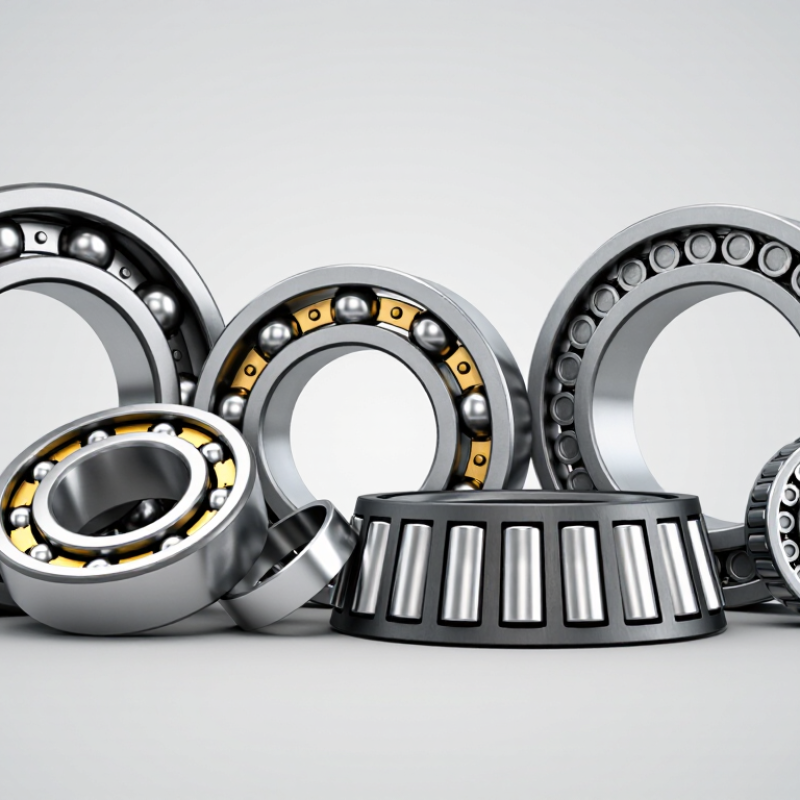
ISO 5593 provides standardized vocabulary for rolling bearings, helping engineers describe bearing parts and arrangements consistently. It is not a ranking of the “best” types. A useful classification starts with the rolling element: balls or rollers. Ball bearings commonly include deep-groove, angular-contact, self-aligning, and thrust designs. Each handles a different mix of radial load, axial load, speed, and alignment conditions. For example, a deep-groove bearing may suit a small electric motor, while an angular-contact design can support combined loads. Small differences matter.

Roller bearings use line contact between rolling elements and raceways, which can support heavier loads in many applications. Common families include cylindrical, needle, tapered, and spherical roller bearings. Cylindrical types often suit high radial loads; tapered types can carry both radial and axial loads. Spherical roller bearings accommodate some shaft misalignment, while needle bearings fit tight spaces. These are general tendencies, not guarantees. Actual capacity depends on dimensions, internal clearance, lubrication, fit, and operating conditions. A neat category name alone cannot predict service life.

Tips: Check the load direction, available space, speed, and possible misalignment before selecting a family. Then verify the exact bearing specification and installation requirements. If the application data is incomplete, pause and measure again; a rushed choice can be costly.

Ball Bearing Types: Deep-Groove, Angular-Contact, Thrust, and Self-Aligning

Deep-groove ball bearings are common in electric motors, fans, and small pumps. They handle radial loads well and can also support modest axial loads. Their simple design suits high speeds and routine service. But a loose fit or poor lubrication can still create heat and noise. Small details matter.

Angular-contact bearings support combined radial and axial loads, making them useful in machine-tool spindles and pump shafts. They are often installed in pairs; arrangement affects stiffness and load capacity. Thrust ball bearings carry axial loads, such as force along a vertical shaft, but are not intended for substantial radial loads. Self-aligning ball bearings can tolerate limited shaft or housing misalignment. That can help when supports are not perfectly aligned, though they cannot correct a badly designed assembly. Catalog ratings are useful, not a substitute for checking real operating conditions.

Tips: Check load direction, speed, temperature, and available space before choosing. Confirm shaft fit and lubrication requirements, too. If vibration remains after installation, alignment may be part of the problem. No bearing type fixes every setup.

Roller Bearing Types: Cylindrical, Tapered, Spherical, and Needle

Roller bearing types solve different problems, so the “top” choice depends on load, alignment, space, and speed. Cylindrical roller bearings carry substantial radial loads and suit shafts that need firm support. Their rollers make line contact with raceways, spreading force across a wider area than point-contact designs. Axial capacity varies by bearing arrangement and flange design. Check the manufacturer’s load and speed ratings before specifying one.

Tapered roller bearings handle combined radial and axial loads. Their angled rollers guide the shaft, while paired bearings can support thrust in both directions. Correct clearance or preload matters: too much can allow movement, while too little can raise operating temperature. Spherical roller bearings are useful where shafts may deflect or housings may be slightly misaligned. Their curved raceways allow self-alignment, but this does not eliminate the need to check lubrication and mounting conditions. Fit matters.

Needle roller bearings offer high radial capacity in a small cross-section. They can suit compact gearboxes, pivots, and transmission components where radial space is limited. Their small rollers need suitable raceway hardness, surface finish, and lubrication. A narrow housing may look ideal on a drawing, yet leave little room for grease or heat control. That detail is easy to underestimate. Compare operating speed, shock loads, contamination, and service access before choosing a type.

What Are the Top Ball and Roller Bearing Types in 2026?

Typical design tendencies across common bearing types

Ratings are qualitative design tendencies on a 1–5 scale, not standardized performance scores. Cylindrical and spherical roller bearings generally suit higher radial loads; tapered roller and angular-contact ball bearings are designed to handle combined radial and axial loads. Spherical roller and self-aligning ball bearings accommodate misalignment. Actual performance depends on bearing design, size, fit, lubrication, and operating conditions.

ISO 281 Rating-Life Formula: p = 3 for Balls and 10/3 for Rollers

ISO 281:2007 gives the basic rating-life relationship L10 = (C/P)^p, where C is dynamic load rating and P is equivalent dynamic load. The exponent is 3 for ball bearings and 10/3 for roller bearings. ISO’s L10 basis represents the life that 90% of a sufficiently large group of identical bearings are expected to reach or exceed under stated conditions. It is a statistical estimate, not a service-life guarantee.

The exponents show why load changes matter. If equivalent load rises by 20%, calculated basic life falls about 42% for balls and 47% for rollers, assuming other inputs remain constant. That difference comes directly from the ISO formula. Small changes count. In practice, a misaligned shaft or uneven housing support can raise local loads beyond the neat catalog calculation.

Still, the exponent alone cannot identify the “top” bearing type for every application. Ball bearings often suit higher speeds and moderate loads; roller designs commonly support heavier radial loads. Lubrication, contamination, fit, temperature, and operating duty can shift actual life sharply. The ISO rating method is useful for comparing designs, but it simplifies real conditions. Engineers should verify the load assumptions and inspect operating evidence rather than treat L10 as a countdown.

What Are the Top Ball and Roller Bearing Types in 2026? - ISO 281 Rating-Life Formula: p = 3 for Balls and 10/3 for Rollers

Bearing Type Rolling Element Typical Load Capability ISO 281 Life Exponent (p) Key Design Characteristic Common Applications
Deep-Groove Ball Bearing Ball Primarily radial; also supports moderate axial loads in both directions 3 Versatile design with low friction; available in open and sealed configurations Electric motors, pumps, fans, and household equipment
Angular-Contact Ball Bearing Ball Combined radial and axial loads; a single bearing generally carries axial load in one direction 3 Designed for combined loading; paired arrangements can support axial loads in both directions Machine-tool spindles, pumps, and precision equipment
Self-Aligning Ball Bearing Ball Primarily radial, with limited axial capacity depending on the design 3 Accommodates a degree of shaft-to-housing misalignment Fans, conveyors, and machinery with possible shaft deflection
Thrust Ball Bearing Ball Axial loads; generally not intended for substantial radial loads 3 Available in single- and double-direction arrangements Vertical shafts, turntables, and axial-load support assemblies
Cylindrical Roller Bearing Roller High radial loads; axial capacity depends on flange and bearing configuration 10/3 Line contact supports high radial load; some designs allow axial displacement Electric motors, gearboxes, and industrial machinery
Spherical Roller Bearing Roller High radial loads and substantial axial loads in both directions 10/3 Self-aligning design accommodates misalignment and shaft deflection Mining equipment, paper machinery, and heavy-duty conveyors
Tapered Roller Bearing Roller Combined radial and axial loads; a single-row bearing typically carries axial load in one direction 10/3 Often installed in pairs to support axial loads in both directions and control clearance or preload Vehicle wheel hubs, gearboxes, and machine-tool assemblies
Needle Roller Bearing Roller High radial loads for a compact cross-section; usually limited axial capacity 10/3 Long, small-diameter rollers provide high radial load capacity in restricted space Automotive transmissions, compact gear drives, and agricultural machinery

ISO 281 basic rating-life reference: L10 = (C/P)p million revolutions, where C is the basic dynamic load rating, P is the equivalent dynamic bearing load, and p is 3 for ball bearings or 10/3 for roller bearings. L10 is the basic rating life associated with 90% reliability under the standard rating conditions; actual service life can vary with lubrication, contamination, mounting, and operating conditions.

Comparing Load, Speed, and L10 Life at 90% Reliability Under ISO 281

What Are the Top Ball and Roller Bearing Types in 2026?

Bearing comparisons become useful when load, speed, and calculated life share the same basis. ISO 281:2007 defines basic rating life, L10, as the life reached by 90% of a sufficiently large group of identical bearings under stated conditions. Its equation is L10 = (C/P)p million revolutions. The exponent p is 3 for ball bearings and 10/3 for roller bearings.

A vital distinction. This is a statistical rating, not a promised service interval.

Deep-groove ball bearings suit many radial-load, higher-speed applications; angular-contact types also carry axial load. Cylindrical rollers handle substantial radial loads, while tapered and spherical rollers accommodate combined loads or misalignment.

ISO 281’s formula shows why load matters sharply: doubling equivalent load P cuts calculated life to one-eighth for ball bearings, and roughly one-ninth for roller bearings. Under constant speed, hours follow L10h = 1,000,000 × L10 / (60 × rpm). Small changes matter.

These figures are starting points. ISO 281:2007 covers dynamic rating life, while ISO 16281:2008 addresses modified life calculations under internal load distribution and misalignment. Real housings run warmer. Lubricant condition, contamination, mounting fit, and actual load cycles can reduce service life, even when catalog calculations look generous.

For a fair comparison, use the same reliability basis, equivalent load, speed, lubrication assumptions, and operating temperature. The uncomfortable part: field conditions rarely stay perfectly constant.